
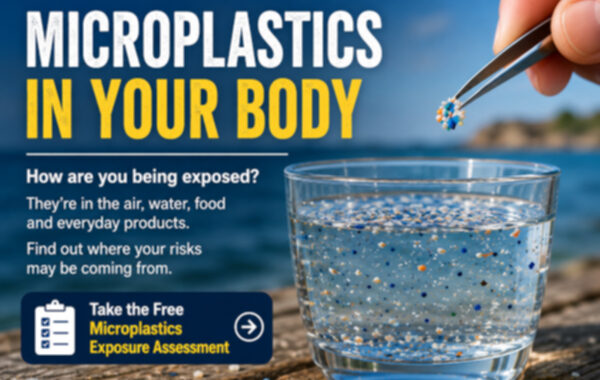
Microplastics in Your Body
Microplastics in Your Body: How Are You Being Exposed?
Microplastics are no longer only an environmental pollution issue. Researchers have detected microplastics in human samples including blood, urine, stool and organs, while studies have also reported their presence in tissues such as the lungs and placenta.
That raises an obvious question:
How are microplastics getting into your body in the first place?
The answer isn't a single product, food or activity. Exposure can occur through ordinary parts of everyday life—including the food we eat, water we drink, air we breathe and products and materials around us.
Understanding those sources is important because while you cannot completely eliminate contact with microplastics, you can identify and reduce unnecessary exposure.
What Are Microplastics?
Microplastics are very small plastic particles, generally described as being less than 5 millimeters in size. Nanoplastics are dramatically smaller—typically less than one micrometer according to the FDA's working description.
They can originate when larger plastic products degrade into progressively smaller particles. They can also enter our surroundings through the manufacture, use and disposal of plastic-containing products.
Because these particles can be extremely small, exposure isn't necessarily something you can see, smell, taste or feel.
How Do Microplastics Get Into Your Body?
There isn't one universal source of exposure.
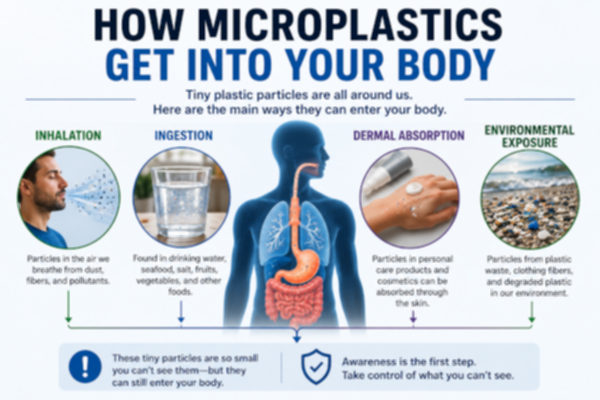
The FDA identifies food, air and potential skin exposure from personal-care products as routes through which people may encounter microplastics and nanoplastics. Research also continues into exposure through drinking water and other environmental sources.
That means exposure can potentially come from multiple parts of daily life: food and beverages, household dust, synthetic materials, plastic products and environmental contamination.
The important point isn't to become afraid of every plastic object around you.
It's to recognize that many small, repeated sources can contribute to your overall exposure.
Where Have Microplastics Been Found in the Human Body?
This is where the issue becomes much more personal.
Microplastics have been reported in numerous human samples and tissues. Scientific literature has described detections involving blood, lungs, placenta, liver, reproductive tissues and other parts of the body.
But detection does not automatically tell us what those particles are doing to human health.
That's an important distinction.
Research into potential biological effects is advancing, but major questions remain about dose, particle size, polymer type, exposure duration and the significance of particles detected in different tissues.
The FDA states that significant research gaps remain and that current scientific evidence does not demonstrate that the levels of microplastics and nanoplastics detected in foods pose a human-health risk. It also notes that analytical methods are not yet sufficiently standardized, making comparisons among studies difficult.
So there are two facts we need to hold at the same time:
Microplastics have been detected inside the human body.
Science has not yet established the full health consequences of that exposure.
Can You Tell How Many Microplastics Are in Your Body?
Not from an online questionnaire—and any website claiming otherwise deserves skepticism.
Laboratory researchers use specialized analytical techniques to identify and characterize microplastics in biological samples. Even within scientific research, differences in sampling, preparation and detection methods remain a significant problem.
An exposure assessment therefore serves a different purpose.
Rather than claiming to measure plastic particles inside your body, it can examine the behaviors and environmental factors that may influence how frequently you encounter them.
That distinction is exactly why we created the free Microplastics Exposure Assessment.
Understanding how microplastics in your body may get there begins with recognizing the everyday routes of exposure—from drinking water and food to household dust and synthetic materials.
How Much Microplastics Exposure Might Be Coming From Your Daily Life?
Think about an ordinary day.
What do you drink? How is your food packaged and stored? What containers do you heat food in? What materials are used throughout your home? How much household dust are you exposed to? What types of products do you routinely use?
Individually, one answer doesn't define your exposure.
Together, however, those behaviors begin to create an exposure pattern.
And that gives you something useful: areas you can actually change.
Reducing Exposure Without Trying to Eliminate Plastic From Your Life
Completely avoiding microplastics in modern life isn't realistic.
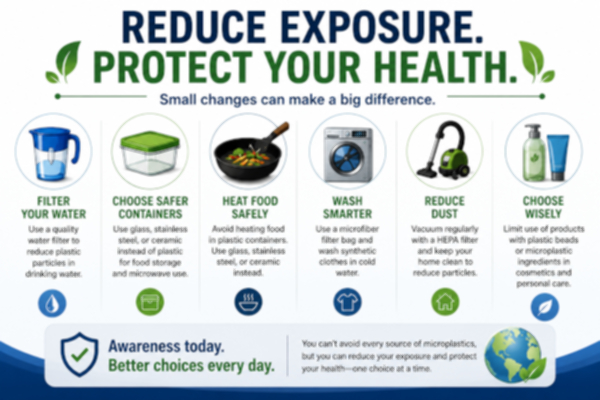
A more practical approach is to identify unnecessary sources and reduce them where reasonable.
That might mean reconsidering how food is stored or heated, reducing unnecessary reliance on disposable plastics, addressing household dust, examining frequently used products, or making other practical changes appropriate to your circumstances.
The objective isn't perfection.
It's awareness followed by better decisions.
Find Out Where Your Exposure May Be Coming From
If you've wondered about microplastics in your body, the more useful question right now may be:
Where might my exposure be coming from?
The free Microplastics Exposure Assessment examines everyday habits and common potential exposure sources to help you identify areas where changes may reduce unnecessary contact.
It does not diagnose a medical condition or measure the amount of plastic in your body.
It gives you something you can act on: a clearer picture of your potential exposure based on your everyday habits.
Take the Free Microplastics Exposure Assessment
Microplastics Exposure Assessment
Scientific source
U.S. Food and Drug Administration — Microplastics and Nanoplastics in Foods
This article is provided for educational purposes and is not medical advice. Research into microplastics, nanoplastics and human health continues to evolve.