
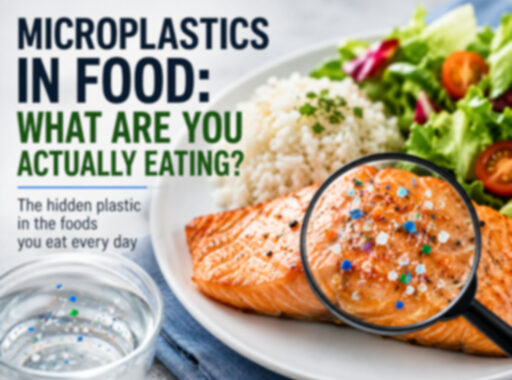
Microplastics in Food: What Are You Actually Eating?
Microplastics in food are no longer just a question about pollution in oceans and waterways. Researchers have detected microscopic plastic particles in a variety of foods and beverages, raising an obvious question: How much plastic are we being exposed to through what we eat and drink?
The answer is not yet simple.
Scientists are still working to determine how much exposure occurs, which particles matter most, and what long-term effects—if any—different levels of exposure may have on human health. What is clear is that microplastics and even smaller nanoplastics have become widespread environmental contaminants capable of entering the food chain.
What Are Microplastics?
Microplastics are extremely small pieces of plastic. The FDA generally describes them as plastic particles smaller than 5 millimeters in at least one dimension. Nanoplastics are much smaller—typically less than one micrometer under the FDA's reference description. Definitions and measurement standards still vary, which is one reason comparing research findings can be difficult.
Some particles originate as small plastics. Others form when larger plastic products gradually break apart through weathering, abrasion, heat, sunlight, and other environmental processes.
Once released, these particles can move through water, soil and air—and ultimately into parts of the food supply.
Microplastics Have Been Found in Food
This isn't merely theoretical.
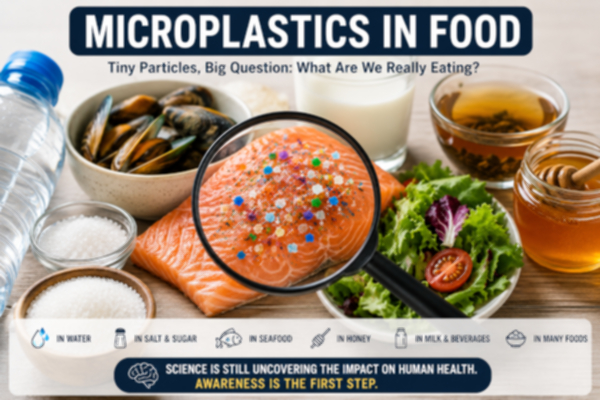
The FDA reports that studies have detected microplastics in foods and beverages including:
- Seafood
- Salt
- Sugar
- Honey
- Milk
- Tea
- Beer
- Bottled water
That does not mean every serving of these foods contains the same amount—or necessarily any detectable amount. Testing methods, particle sizes and sampling procedures vary substantially among studies.
But the larger finding is difficult to ignore: microplastics in food have become part of the scientific investigation into everyday human exposure.
How Do Microplastics Get Into Food?
There isn't one single pathway.
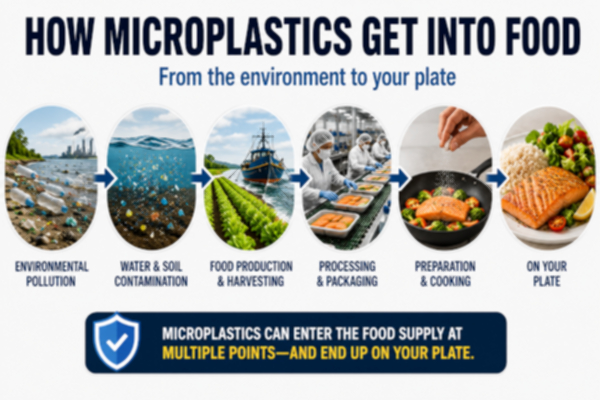
Food can potentially encounter plastic particles at multiple points before reaching your plate.
Environmental contamination is an important route. Plastic waste breaks down into increasingly smaller particles that can enter soil and water. Foods grown, raised or harvested in those environments can consequently encounter microplastics.
Processing, preparation and food-contact materials are also being studied. However, it is important not to overstate what scientists currently know.
The FDA specifically says there is not sufficient scientific evidence showing that microplastics and nanoplastics from plastic food packaging migrate into foods and beverages.
In other words, plastic packaging should not automatically be blamed for every particle detected in food. Environmental contamination and the many stages involved in producing food make the issue considerably more complicated.
What About Bottled Water?
Water is another potential route of exposure.
Studies have reported microplastics and nanoplastics in both bottled and tap water. The FDA currently states that scientific evidence does not demonstrate that the levels detected in water pose a risk to human health.
This distinction matters.
Detection is not the same thing as demonstrated harm.
Modern analytical equipment can detect increasingly small materials. Finding a substance tells us that exposure may occur. It does not, by itself, establish that the detected concentration causes disease.
What Happens After We Eat Them?
This is where the subject becomes especially important—and considerably less certain.
Researchers are investigating what happens to different plastic particles after ingestion, including whether particles remain within the digestive tract, are eliminated, or—particularly at very small sizes—can cross biological barriers.
Microplastics and nanoplastics have been reported in human samples including blood and organs. But major questions remain about exposure levels, particle characteristics and their potential health consequences.
If you want to explore that subject further, read Microplastics in Your Body, which looks specifically at what researchers are learning about plastic particles detected in the human body.
Are Microplastics in Food Dangerous?
This question deserves a careful answer rather than a frightening headline.
We don't yet know enough to quantify the long-term human-health risk from normal dietary exposure.
The FDA states that current scientific evidence does not demonstrate that the levels of microplastics or nanoplastics detected in foods pose a risk to human health. At the same time, the agency acknowledges significant research gaps and continues studying the issue.
There is another major complication: not all plastic particles are identical.
Particle size, shape, polymer type, degradation, chemical additives and exposure level may all matter when scientists evaluate potential effects. That makes the question far more complicated than simply asking whether "plastic is toxic."
For current scientific information about microplastics and nanoplastics in the food supply, see the U.S. Food and Drug Administration's Microplastics and Nanoplastics in Foods resource.
What Can You Do About Microplastics in Food?
Eliminating exposure completely isn't realistic.
Microplastics are already distributed throughout the environment, and exposure can occur through food, water and air.
The practical goal is therefore not perfection. It is identifying avoidable sources of exposure and making reasonable changes where they fit your life.
That can include reducing unnecessary dependence on disposable plastics, reconsidering how foods and beverages are stored and prepared, limiting avoidable plastic contact where practical, and becoming more aware of the products you use every day.
No single change creates a plastic-free life.
But understanding where exposure can occur gives you something much more useful: the ability to make informed choices.
How Much Microplastics Exposure Might You Have?
Food is only part of the picture.
Drinking water, household dust, synthetic materials, food preparation, consumer products and other everyday habits can contribute to potential exposure.
That's why looking at only one food or product doesn't tell you very much about your overall exposure pattern.
The Microplastics Exposure Assessment was created to help you examine those everyday sources together. It is an educational screening tool—not a medical test—and it cannot determine how much plastic is actually inside your body.
Take the Microplastics Exposure Assessment to identify the everyday habits and sources that may be contributing to your potential exposure.
The Bottom Line
Microplastics in food are real, but the science surrounding their health significance is still developing.
Researchers have detected microplastics in numerous foods and beverages, and environmental contamination provides pathways for these particles to enter the food chain. At the same time, scientists do not yet have enough standardized data to determine what levels of dietary exposure may create meaningful human-health risks.
That uncertainty shouldn't be turned into panic.
But it shouldn't be turned into indifference, either.
We don't need to wait until every scientific question is answered before becoming more aware of where plastics enter our lives. We can understand our potential exposure, follow the developing research, and make practical choices to reduce unnecessary contact where possible.