
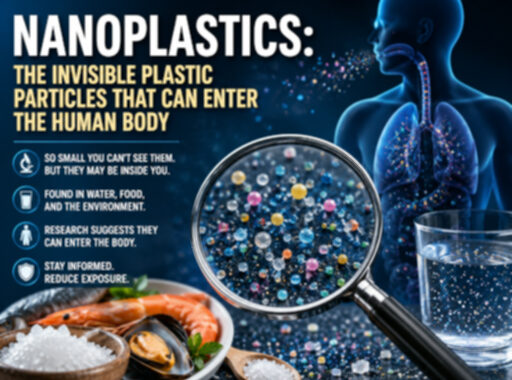
Nanoplastics: The Invisible Plastic Particles That Can Enter the Human Body
Nanoplastics are so small that you cannot see, smell, taste, or feel them. Yet these microscopic particles are becoming an increasingly important subject of scientific research because their extremely small size may allow them to interact with the human body differently from larger plastic particles.
Microplastics have received considerable public attention, but nanoplastics take the issue to an entirely different scale.
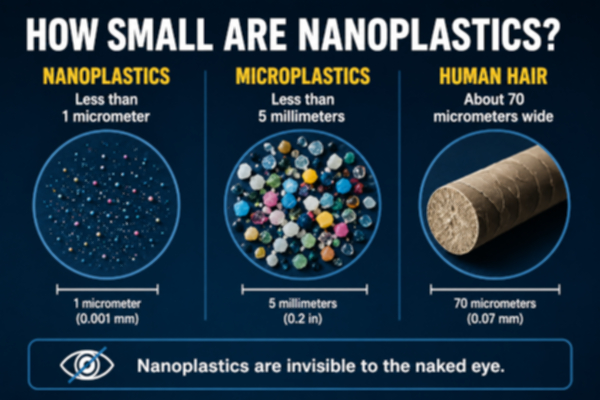
The U.S. Food and Drug Administration describes nanoplastics as plastic particles typically smaller than one micrometer, although there is currently no universally standardized definition. For perspective, a human hair is approximately 70 micrometers in diameter.
That extraordinary difference in size is one reason scientists are trying to understand what happens when these particles enter our food, water, air—and potentially our bodies.
What Are Nanoplastics?
Plastic does not simply disappear when it breaks down.
Larger plastic products exposed to sunlight, weathering, abrasion and environmental conditions can gradually fragment into increasingly smaller pieces. Some eventually become microplastics, and continued fragmentation can produce particles at the nanoscale.
The FDA generally describes microplastics as particles smaller than 5 millimeters in at least one dimension and nanoplastics as particles typically smaller than one micrometer. However, definitions used by researchers can vary.
This distinction is important.
A nanoplastic particle isn't simply a slightly smaller microplastic. At extremely small scales, scientists must consider how particle size and other characteristics affect movement, cellular interaction and biological behavior.
Where Do Nanoplastics Come From?
Nanoplastics can result from the degradation of larger plastic materials already present throughout the environment.
Plastic pollution exists in soil, waterways, oceans and other environments. Because most plastics do not readily biodegrade, they can instead weather and fragment into smaller particles over time.
Potential human exposure is therefore not limited to someone handling a plastic bottle or food container.
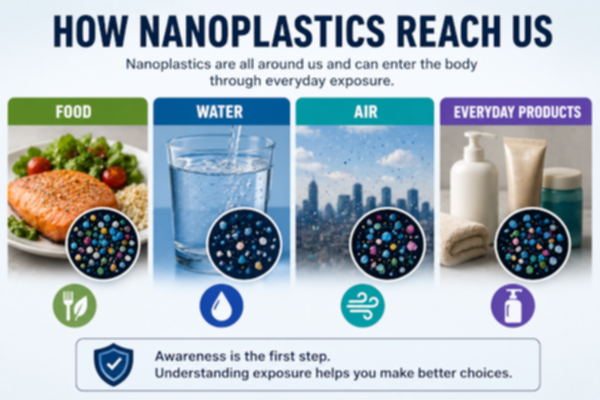
The FDA identifies food, air and dermal contact involving personal-care products as potential exposure routes for microplastics and nanoplastics. The World Health Organization has likewise examined exposure through food, water and air.
This makes plastic-particle exposure an environmental issue rather than simply a packaging issue.
Nanoplastics in Food and Water
Food is one potential route through which people may encounter extremely small plastic particles.
The FDA says evidence suggests that microplastics and nanoplastics are entering the food supply, primarily through environmental contamination where food is grown or raised. At the same time, the agency says there is currently insufficient scientific evidence to demonstrate that microplastics and nanoplastics from plastic food packaging migrate into foods and beverages.
Studies have reported plastic particles in foods and beverages such as seafood, salt, sugar, honey, milk, tea, beer and bottled water, although detecting nanoplastics specifically is considerably more difficult than detecting larger particles.
If you want to examine that exposure route in greater detail, read Microplastics in Food: What Are You Actually Eating?
Water is another area receiving scientific attention. Studies have detected microplastics and nanoplastics in both tap and bottled water. The FDA currently says available scientific evidence does not demonstrate that the levels detected in water pose a human-health risk.
Why Are Nanoplastics So Difficult to Study?
One of the biggest problems facing researchers is surprisingly basic:
Nanoplastics are extraordinarily difficult to detect and measure accurately.
There are currently no standardized methods for detecting, quantifying and characterizing microplastics and nanoplastics across all research. According to the FDA, fewer studies have investigated nanoplastics in food partly because existing scientific measurement methods are not very reliable at detecting polymer particles at such tiny sizes.
Researchers must also distinguish plastic particles from countless other microscopic materials in complex samples.
And particle size isn't the only variable.
Plastic particles can differ in:
- Size
- Shape
- Polymer composition
- State of degradation
- Surface characteristics
- Chemical additives
Those differences complicate attempts to determine exposure and biological effects.
Consequently, two studies investigating "nanoplastics" may not necessarily be investigating particles with identical characteristics.
Can Nanoplastics Enter the Human Body?
Researchers have reported microplastics and nanoplastics in human biological samples, including blood, urine, stool and organs.
Recent scientific reviews have also examined findings involving plastic particles across multiple human organ systems and biological samples. However, researchers continue to emphasize limitations involving detection methods, study design, confounding factors and the ability to establish cause and effect.
This distinction is critical.
Finding plastic particles in the body does not automatically prove that those particles caused a particular disease.
Detection establishes presence. Establishing health consequences requires substantially more evidence.
For a closer look at what scientists have detected in human tissues and biological samples, read Microplastics in Your Body.
What Could Nanoplastics Do Inside the Body?
This is one of the most actively investigated—and potentially misunderstood—parts of the subject.
Laboratory research has investigated biological mechanisms including inflammation, oxidative stress, cellular damage and mitochondrial dysfunction. A 2026 systematic review reported that experiments using human-derived cell lines found effects including oxidative stress, inflammation, DNA damage and other cellular disruptions, with particle size, polymer type and concentration affecting the results.
But laboratory findings cannot simply be translated into predictions about what will happen to a person during ordinary everyday exposure.
Exposure concentrations, particle characteristics, duration and biological conditions all matter.
A separate 2026 systematic review of research involving living human subjects found associations between micro- and nanoplastic burdens and several biological or clinical findings. However, its authors specifically cautioned that methodological differences, confounding and exposure-measurement bias limit causal conclusions.
That is why the science requires careful language.
There are reasons to investigate nanoplastics seriously.
There is not yet justification for claiming that everyday nanoplastic exposure has been proven to cause specific diseases in humans.
Are Nanoplastics Dangerous?
At present, science cannot give us a simple yes-or-no answer.
The FDA states that current scientific evidence does not demonstrate that the levels of microplastics or nanoplastics detected in foods pose a risk to human health. It also emphasizes that significant research gaps remain and that more research is needed before potential human-health effects can be adequately assessed.
That's an important distinction.
It would be inaccurate to say nanoplastics have been proven harmless.
It would also be inaccurate to say normal everyday exposure has been proven to cause disease.
The scientifically defensible position lies between those claims: human exposure is being documented while researchers work to determine what that exposure means for long-term health.
For current information from the federal agency responsible for food safety, see the FDA's Microplastics and Nanoplastics in Foods resource.
Why Nanoplastics Deserve Attention
The absence of complete evidence is not the same as the absence of a legitimate research question.
Plastic pollution is widespread. Plastic particles can become extremely small. Human exposure occurs through multiple pathways. Plastic particles have been detected in human biological samples, and scientists are investigating their interactions with cells and tissues.
At the same time, researchers still face major problems measuring the smallest particles accurately.
That means nanoplastics occupy an uncomfortable scientific position: we increasingly know they are present, while important questions about exposure and health consequences remain unresolved.
That isn't a reason for panic.
But it certainly isn't a reason to stop investigating them.
How Much Plastic Exposure Might You Have?
You cannot look at your food, water or household environment and determine your nanoplastics exposure simply by sight.
Potential exposure can come from multiple parts of everyday life, including food, drinking water, household environments and other sources.
Rather than focusing on a single product, it makes more sense to look at the habits and potential exposure sources that occur repeatedly.
The Microplastics Exposure Assessment was created to help you do exactly that. It examines everyday behaviors and common sources that may contribute to potential microplastics and nanoplastics exposure.
It is an educational screening tool—not a medical test—and cannot determine the amount of plastic actually present in your body.
Take the Microplastics Exposure Assessment and identify the everyday sources and habits that may be contributing to your potential exposure.
The Bottom Line
Nanoplastics represent one of the most difficult parts of the plastic-pollution problem to understand precisely because they are so small.
They cannot be seen during ordinary daily life. Detecting them scientifically is challenging. Standardized measurement methods remain under development, and researchers are still working to understand how particle size, composition and exposure influence biological effects.
What we know is enough to justify continued attention.
Plastic pollution can fragment into microscopic and nanoscale particles. People can encounter these particles through environmental exposure routes. Plastic particles have been detected in human samples, and research into their potential biological effects is continuing.
What we don't yet know is equally important.
Scientists have not established precisely what levels of everyday nanoplastics exposure create human-health risks or whether many of the associations now being investigated represent causal relationships.
Awareness therefore doesn't require fear.
It requires understanding what is known, recognizing what remains uncertain, reducing unnecessary exposure where practical, and continuing to pay attention as the science develops.