
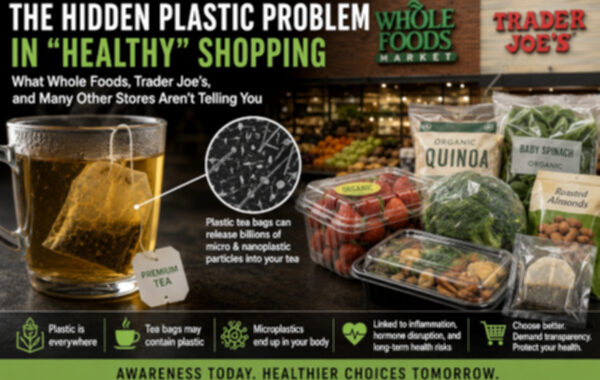
Whole Foods, Trader Joe’s, and the Plastic Problem Hidden Inside “Healthy” Shopping
People walk into stores like Whole Foods and Trader Joe’s believing they are making safer, healthier choices.
The lighting feels softer. The signs talk about wellness, sustainability, clean ingredients, natural living, organic sourcing, and environmental responsibility. The branding communicates trust before customers even place a single item into their carts.
Consumers pay premium prices because they believe these stores represent something fundamentally healthier than conventional grocery chains.
But once you begin looking closely, another reality becomes difficult to ignore.
Plastic is everywhere.
Organic apples wrapped in plastic trays. Pre-cut fruit sealed inside petroleum-based containers. “Healthy” frozen meals in black plastic. Snacks packaged in multilayer synthetic films. Drinks lined with plastic barriers. Bulk foods stored in plastic systems behind the scenes. Plastic produce bags hanging in endless rows beneath signs promoting sustainability.
Even many tea products — products people buy specifically for health, relaxation, recovery, detoxification, or wellness — may contain hidden plastics directly inside the tea bags themselves.
Most consumers never realize it.
Tea carries one of the strongest health associations in modern culture. People drink tea when they want to relax, reduce stress, sleep better, support digestion, improve focus, or simply live more consciously. It is viewed as one of the healthier alternatives to processed beverages.
But many modern tea bags are no longer simple paper filters.
Some contain polypropylene, nylon, polyethylene, synthetic mesh materials, heat-sealed plastics, or plastic reinforcement fibers designed to keep the bags from tearing apart in boiling water. Even tea bags marketed as “premium,” “silken,” or “plant-based” may still contain synthetic materials hidden within the structure.
The result is deeply ironic.
Consumers seeking health and wellness may unknowingly pour microscopic plastic particles directly into near-boiling water multiple times per day.
Research has already raised serious concerns about this exposure pathway. Scientists at McGill University found that certain plastic tea bags released billions of microplastic and nanoplastic particles into a single cup during steeping.
Billions.
Not trace amounts. Not theoretical contamination. Billions of particles entering hot liquid intended for human consumption.
The larger issue is not simply one tea bag or one product line. It is the contradiction underneath the modern health-food industry itself.
Stores marketed around wellness still operate inside highly plastic-dependent systems.
Consumers are surrounded by language suggesting safety and purity:
- organic,
- eco-friendly,
- natural,
- sustainable,
- wellness-focused,
- clean ingredients,
- responsibly sourced.
But none of those terms automatically mean:
- plastic-free,
- microplastic-free,
- toxin-free,
- or chemically safer.
That distinction matters.
Because modern consumers increasingly assume that expensive health-focused products are inherently cleaner at every level. In reality, much of the packaging infrastructure remains almost identical to conventional retail systems.
The psychology behind this is powerful.
Most people do not inspect packaging chemistry. They do not research polymer composition. They do not study thermal degradation of synthetic fibers. They trust branding. They trust imagery. They trust marketing language that implies care, safety, environmental responsibility, and health consciousness.
And to be fair, many companies likely are trying to improve portions of their supply chains. But the broader system still relies heavily on disposable plastics because plastic remains cheap, lightweight, scalable, profitable, and deeply embedded into global food distribution infrastructure.
That dependence now collides with a growing body of research surrounding microplastics and human exposure.
Microplastics have already been identified in:
- human blood,
- arteries,
- lungs,
- placentas,
- reproductive tissue,
- breast milk,
- and other organs throughout the body.
Scientists continue studying the long-term consequences, but concerns already include:
- inflammation,
- oxidative stress,
- endocrine disruption,
- immune system dysfunction,
- gut microbiome disruption,
- cardiovascular effects,
- and reproductive health impacts.
The issue becomes even more concerning when exposure is repetitive and cumulative.
One plastic tea bag may seem insignificant in isolation.
But modern exposure rarely comes from one source.
It comes from:
- bottled beverages,
- plastic food packaging,
- synthetic clothing fibers,
- takeout containers,
- nonstick coatings,
- processed foods,
- dust particles,
- water systems,
- household products,
- and repeated daily food contact.
The body does not experience these exposures separately. They accumulate within the same biological systems over time.
This is why the conversation surrounding stores like Whole Foods and Trader Joe’s matters.
Consumers deserve transparency.
If a tea bag contains plastic, that should be clearly disclosed.
If “compostable” packaging still contains synthetic polymers, consumers should know.
If health-oriented brands continue relying heavily on single-use plastics while promoting wellness-centered lifestyles, the public has a right to question the contradiction.
None of this requires panic or perfection.
Modern consumers cannot eliminate every exposure source overnight. The system is too widespread for that.
But awareness changes behavior.
Many consumers are now:
- switching to loose-leaf tea,
- using stainless steel or glass infusers,
- reducing ultra-processed packaged foods,
- avoiding heating food in plastic,
- choosing glass whenever possible,
- bringing reusable produce bags,
- and paying closer attention to packaging materials instead of branding alone.
The larger issue extends beyond grocery stores.
This is ultimately a conversation about whether modern convenience has quietly outpaced long-term biological safety.
For decades, plastic was treated primarily as an environmental problem — litter, landfill accumulation, ocean pollution, and wildlife contamination.
Now the issue is becoming personal.
The plastic problem is no longer only around us.
It is increasingly inside us.
And consumers seeking healthier lives are beginning to realize that wellness branding means very little if the underlying system still depends heavily on the same materials contributing to the growing microplastic crisis.